

Posted By
Chaya Gray

Date
June 21, 2024

Comments
0
FROZEN SHOULDER- When Your Shoulder Stops Listening to You
A small note before you begin –
Frozen shoulder is a journey that needs patience — and so does this guide. Read slowly, don’t rush, and you’ll find the answers you’ve been looking for. Take your time — if you skim too quickly, you may skip information that directly affects your recovery decisions.
This article is written as FREE clinical guidance to help you understand and handle frozen shoulder with clarity, confidence, and realistic expectations.
It is not meant to replace medical consultation — rather, it prepares you to make better decisions, recognise what phase you are in, and choose movements and habits that support recovery instead of slowing it down.
What you’ll learn here:
1️⃣ Why frozen shoulder happens — in simple language you can explain to your family
2️⃣ How to recognise your phase — because treatment changes depending on timing
3️⃣ What really helps — safe exercises, habits, diet & supplement guidance to support healing
4️⃣ What to avoid — movements and mistakes that increase inflammation or delay recovery
5️⃣ When to seek medical help — red flags and referral signals
If you like, you can save or bookmark this page —
frozen shoulder takes time, and this guide can walk with you through every phase.
PART 1 — WHEN YOUR SHOULDER STOPS LISTENING TO YOU
Frozen shoulder often begins quietly — no fall, no injury, just a slow, confusing tightening of the shoulder.
Patients tell me:
“I didn’t hurt myself, but suddenly I can’t reach my bra strap.”
“Turning in bed wakes me with a sharp pain.”
Daily movements start to feel heavier than they should:
- reaching a shelf
- combing hair
- putting on a shirt
- reaching the back pocket
- hugging someone properly
The most surprising part?
The shoulder aches the most when you’re resting — especially at night. People think it will settle on its own, but weeks pass and movement reduces even more. You move less because it hurts… and the shoulder stiffens because you move less.
If this feels familiar, breathe:
You didn’t cause this. You didn’t miss a warning.
Frozen shoulder has its own rhythm —
but with the right guidance, it can thaw.
When patients ask me,
“Will I ever get my arm back?”
my answer is:
Yes — in most cases, movement returns. Not suddenly, but step by step, as the joint slowly regains space and glide.
Frozen shoulder is not weakness or aging —
it’s a temporary, reversible tightening of the shoulder capsule, and with phase-based movement, you can restore mobility again.
PART 2 — WHAT’S ACTUALLY HAPPENING INSIDE YOUR SHOULDER
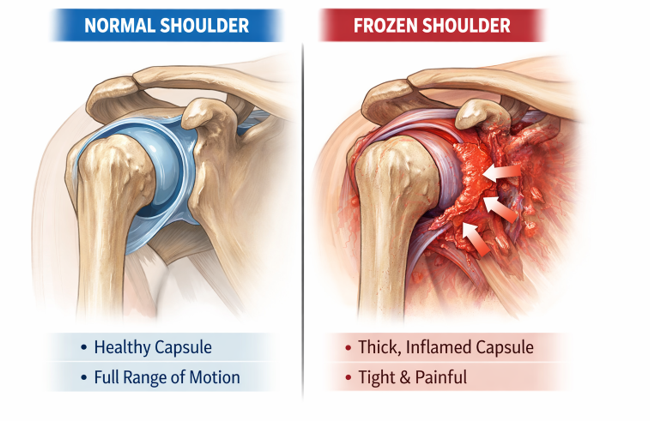
Frozen shoulder is not a single event — it’s a process happening inside the joint capsule, the thin elastic sleeve that surrounds your shoulder joint and allows smooth movement in every direction.
Think of this capsule as a flexible shirt sleeve around the ball of the shoulder (humeral head).
When healthy, this sleeve stretches easily and creates space for your arm to move — which is why reaching overhead, behind your back, or across your body normally feels free and natural.
But in frozen shoulder, something changes inside this capsule: Let’s understand this-
Step 1 — The capsule becomes inflamed
For reasons that are not always dramatic or obvious, the capsule begins to irritate and swell.
This inflammation can be triggered by:
- diabetes or prediabetes
- thyroid issues
- hormonal shifts around menopause
- post-surgery or post-injury protection
- or sometimes for no clear reason at all
Early on, this inflammation makes the shoulder painful — especially at night.
Many patients say:
“I wake up if I turn to that side… even the bedsheet touch feels sharp.”
Step 2 — The capsule becomes thick, tight and sticky
With time, the inflamed capsule starts to:
- thicken
- lose elasticity
- form internal adhesions (stickiness)
- shrink slightly around the joint
It’s like a stretchable shirt that went through too many hot washes —
now tighter, less forgiving, and harder to move inside.
This is the stage where patients say:
“I can’t reach my back pocket… I feel stuck.”
Step 3 — Movement becomes restricted
Because the capsule is tighter, it physically limits space inside the joint.
This is why:
- lifting your arm overhead becomes difficult
- internal rotation (hooking bra / reaching belt) becomes restricted
- rotating the arm outward feels blocked
It’s not just pain —
there is less room for the humeral head to glide. Even if muscles are strong, the capsular restriction holds movement back.
The confusing cycle
Pain → less movement → more tightening → more stiffness → even less movement
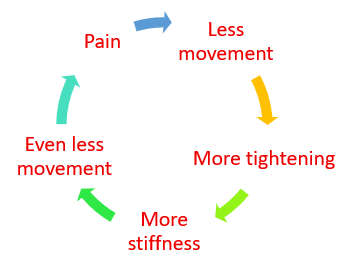
This cycle can frustrate patients into thinking:
“I’m getting weaker… my shoulder is gone.”
But the truth is:
The shoulder is not permanently damaged —the capsule is temporarily stiff.
The hopeful part — this can reverse!
Just as the capsule thickened and tightened, it can gradually soften and remodel again with:
- guided movement
- stretching at the right phase
- inflammation control
- nutrition & supplements that support tissue healing
- patience and consistency
Movement returns not all at once, but like ice melting across a season.
Why this matters before treatment?
Understanding what is happening inside helps you avoid the biggest mistake:
forcing aggressive stretching during the painful (inflamed) stage, which can increase irritation and slow down recovery. In frozen shoulder, what you do depends on when. And that brings us to the next section.
PART 3 — THE 3 PHASES OF FROZEN SHOULDER (CLEAR, PRACTICAL & COMPLETE)
Frozen shoulder moves through three phases, and each phase needs a different approach.
If you treat the wrong phase with the wrong exercise, recovery slows — that’s why this section matters.
Use the descriptions below to identify which phase you are in right now.
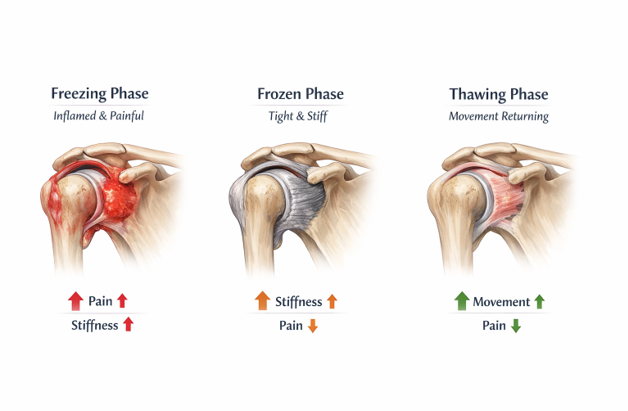
1️⃣ Freezing Phase — Pain first, stiffness starts later
Main sign:
🔹 Pain is the biggest problem
How it feels
- sharp pain with certain movements
- night pain and sleep disturbance
- twitching pain when reaching suddenly
- stiffness just beginning
What’s happening inside-
The capsule is inflamed and irritated, so it reacts to movement like sore skin reacts to rubbing.
What this phase needs
→ Calm the inflammation, move gently
→ Do NOT force range yet (this worsens irritation)
If this sounds like you:
your focus = pain control + gentle motion
2️⃣ Frozen Phase — Stiffness becomes the main limitation
Main sign:
🔹 Pain reduces, but the shoulder feels blocked
How it feels
- daily activities feel restricted: reaching, dressing, tying apron strings
- arm feels “stuck halfway” or “won’t go where I want it to”
- pain is tolerable, but stretching feels tight
What’s happening inside
Inflammation is settling, but the capsule is thick, tight and less elastic, limiting movement — like a shirt sleeve that shrank.
What this phase needs
→ Stretching + mobility work
→ Regular practice (small improvements add up)
If this sounds like you:
your focus = gradual stretching + controlled strengthening
3️⃣ Thawing Phase — Movement returns slowly
Main sign:
🔹 You can move further than before
How it feels
- range of motion increases month by month
- daily activities feel easier again
- strength starts coming back naturally
What’s happening inside-
The capsule is slowly remodeling — gaining elasticity again, like ice melting into water.
What this phase needs
→ Stretch + strengthen + functional tasks
→ Consistency to regain full motion and confidence
If this sounds like you:
your focus = restore full range + build strength + keep using the arm
Phase | Main Issue | Months (average) |
Freezing | Pain | 3–9 |
Frozen | Stiffness | 4–12 |
Thawing | Mobility returns | 6–24 |
Some people move faster, some slower — especially if diabetes, thyroid issues, or inactivity are present.
The simplest way to remember
Freezing: calm it
Frozen: stretch it
Thawing: strengthen it
Not the other way around.
Your next question is always this:
“So which exercises should I do in each phase?” And that’s exactly what I will cover next.
PART 4 — WHAT NOT TO DO WITH FROZEN SHOULDER
(so you don’t slow down your own recovery)
Many people worsen frozen shoulder without realizing it. These are the most common mistakes I see in patients — and what they lead to.
❌ 1. Forcing painful stretches early
“No pain, no gain” does not apply here.
Why avoid:
In the Freezing Phase, aggressive stretching increases inflammation, making pain worse and delaying recovery.
Better instead:
→ gentle pain-free mobility
→ heat → move → ice if needed
❌ 2. Completely resting the arm
Waiting for the shoulder to fix itself does the opposite.
Why avoid:
Long rests make the capsule tighten more, especially in the Frozen Phase.
Better instead:
→ small daily movements to keep the joint alive
→ stretching + light strength as pain settles
❌ 3. Ignoring night pain
Night pain is not just “age” — it’s a sign of inflammation.
Why avoid:
Sleeping on the painful shoulder or lying flat triggers irritation.
Better instead:
→ support the arm with pillows
→ avoid direct side-lying on the painful side
→ heat before bed reduces nighttime flare
❌ 4. Chasing quick fixes
Steroid injection, massage, or shock therapy alone won’t “cure” it.
Why avoid:
These may help pain temporarily, but without movement guidance, stiffness returns.
Better instead:
→ consider injections alongside phase-based exercises — not instead of them
❌ 5. Using only YouTube exercises
Random exercises = random results.
Why avoid:
You may be doing Frozen-phase stretches in Freezing-phase pain, which sets you back.
Better instead:
→ exercise matched to your phase
(and that’s exactly what the next part covers)
❌ 6. Stopping because pain reduces
Pain going down ≠ shoulder fully recovered.
Why avoid:
Many stop in the Thawing Phase when pain improves —but movement hasn’t fully returned, and stiffness creeps back later.
Better instead:
→ continue stretching + strengthening even when pain fades
Key message
Don’t fight the phase — work with it. Forcing too early or stopping too early are the two biggest delays.
PART 5 — EXERCISES YOU NEED (BASED ON YOUR PHASE)
Do the right exercise at the right time — that’s the fastest path to recovery.
Not every exercise is safe in every phase. The wrong exercise at the wrong time = setback.
So start by identifying your current phase from Part 3, then follow the matching section below.
1️⃣ FREEZING PHASE — High pain, early stiffness
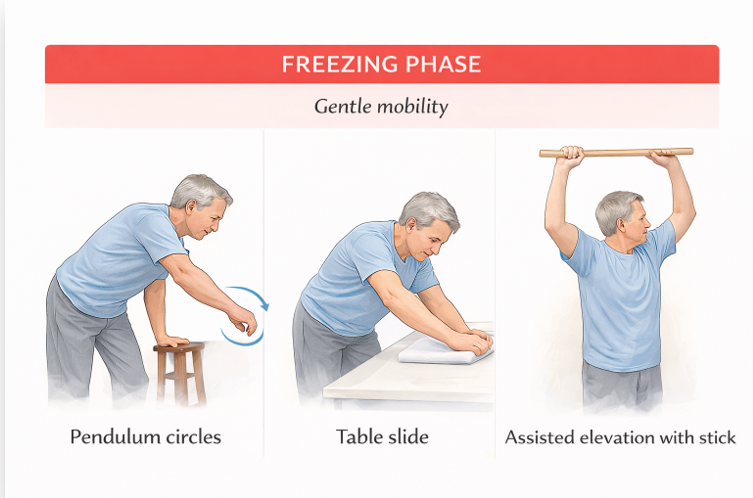
Goal: Keep the shoulder moving gently without increasing pain
Rule: “Move, don’t force.”
Exercise | How it helps | How to do |
Pendulum circles | relieves pressure, relaxes joint | lean forward, let arm hang, make small circles — 1 min clockwise & anticlockwise |
Table slide forward | maintains flexion safely | sit, place hands on towel on table, slide forward keeping shoulders relaxed — 10–15 reps |
Assisted elevation with stick | gentle upward movement | hold stick with both hands, unaffected arm lifts affected arm — 10 reps pain-free |
Shrugs & scapular squeezes | keeps shoulder blade active | shoulders up–down, then squeeze blades 10–10 reps |
Frequency:
1–2 times daily, short sets, no sharp pain
Avoid now:
🚫 cross-body stretch
🚫 internal rotation stretch
🚫 wall climbing aggressively
2️⃣ FROZEN PHASE — Stiffness is the main issue
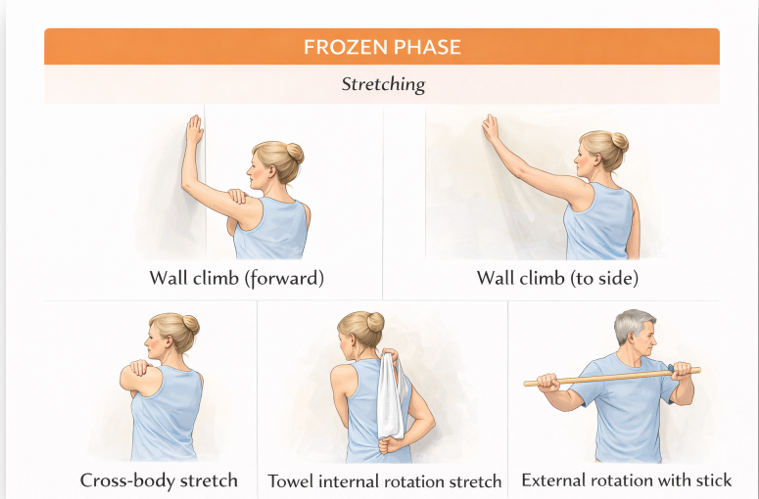
Goal: Regain range — slowly stretch the capsule
Rule: “Stretch what feels tight — daily.”
Exercise | How it helps | How to do |
Wall climb (forward & to side) | improves overhead range | walk fingers up wall, hold 10–20 sec, slowly down — 6–8 reps |
Cross-body stretch | targets posterior capsule | pull affected arm across chest, hold 20–30 sec × 3 |
Towel internal rotation stretch | helps reach behind back | hold towel behind, use top hand to pull gently — 15–20 sec × 3 |
External rotation with stick | key for functional rotation | elbow by side, push stick outward gently — 15 sec × 5 |
Doorway pec stretch | frees front tightness | forearm on doorway, lean forward — 20 sec × 3 |
Frequency:
Once daily stretching + 3–4 strengthening days/week
Expect: a stretching discomfort is okay —
sharp pain means stop.
3️⃣ THAWING PHASE — Movement improving
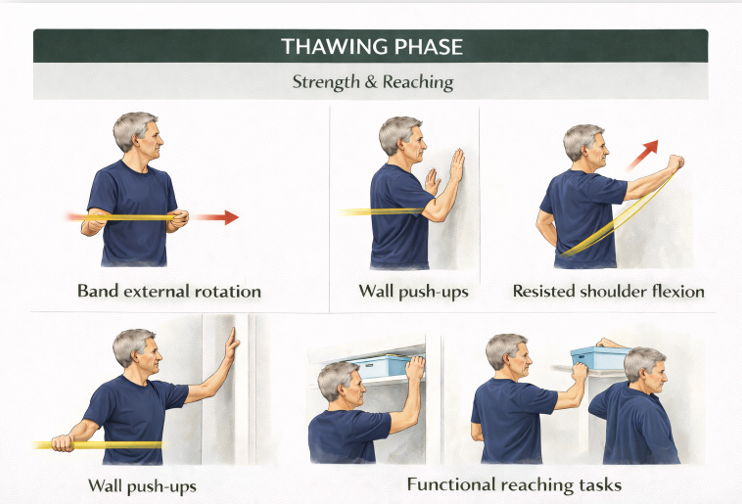
Goal: Build strength + confidence while finishing range
Rule: “Stretch + strengthen + use the arm in real life.”
Exercise | Focus | Prescription |
Band external rotation | rotator cuff strength | 3 × 12 reps |
Band internal rotation | functional strength | 3 × 12 reps |
Wall push-ups | shoulder stability & strength | 3 × 10 reps |
Resisted shoulder flexion | overhead reach strength | 2 × 8 reps |
Functional reaching tasks (shelves, hair, dressing) | real-life confidence | daily practice |
Continue stretching from Frozen Phase —
muscles need both strength and flexibility now.
QUICK SUMMARY — Your Phase → Your Action
Phase | Main Goal | Best Exercises |
Freezing | calm pain + keep motion | pendulum, table slide, assisted elevation |
Frozen | stretch capsule | wall climb, cross-body, towel stretch |
Thawing | restore strength & function | band exercises, push-ups, daily tasks |
What progress should feel like
- stretching discomfort = normal
- sharp catching pain = stop
- slow improvement over weeks = expected
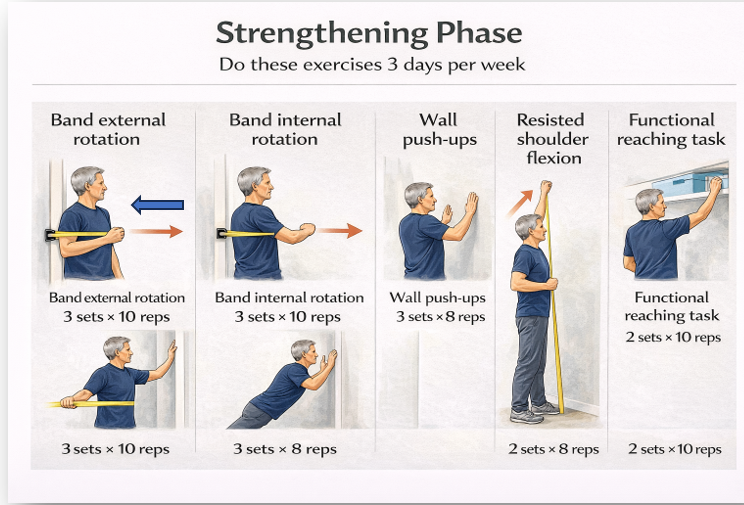
PART 6 – STRENGTHENING PHASE — SIMPLE GUIDE
What Exactly Is the Strengthening Phase? (Simple Explanation for Patients)
Once pain has reduced and movement has started to return, your shoulder enters what we call the Strengthening Phase.
This stage usually comes after months of stiffness, and it’s the moment your shoulder finally begins to trust movement again.
During frozen shoulder, the capsule becomes tight — but the muscles around the shoulder also become weak, simply because you haven’t been able to use your arm fully.
When the capsule begins to “thaw,” there is new space to move, but the muscles are not ready to support that space yet.
If we stop here, the shoulder often becomes stiff again.
The Strengthening Phase prevents that backward slide.
Think of it this way:
Stretching opens the door… but strengthening keeps it open.
This phase gently trains the rotator cuff, shoulder blade muscles, and the front of the shoulder, so your arm becomes strong enough to:
- reach overhead
- lift objects safely
- sleep without protection
- comb hair or fasten clothes
- carry bags
- work, cook, and move without fear
Strengthening is not about heavy weights — it’s about controlled movements, regular practice, and listening to your body.
When done correctly, this phase turns temporary movement into lasting freedom, so the shoulder doesn’t tighten again once the pain disappears.
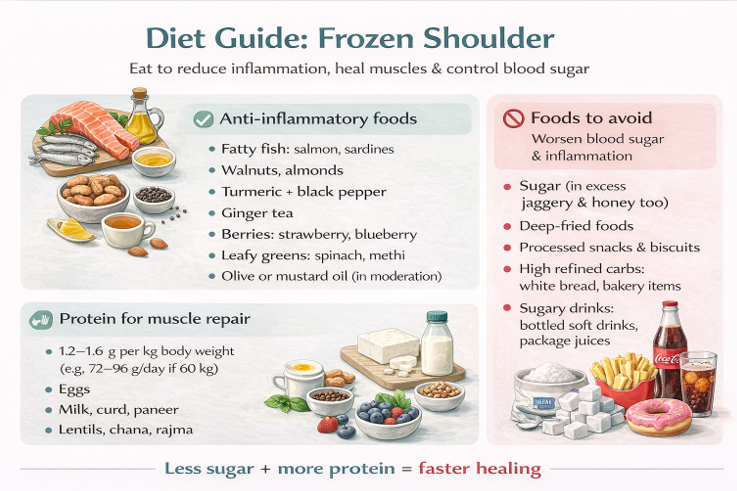
PART 7- DIET GUIDELINES — WHAT HELPS YOUR SHOULDER HEAL
Rule of thumb:
“Less sugar, more protein, daily anti-inflammatory foods.”
Night pain hack
One cup warm turmeric milk or ginger tea
30–45 minutes before sleeping can calm inflammation and improve sleep.
Frozen shoulder is not only a joint problem — it’s also influenced by inflammation, healing capacity, blood sugar balance, and daily habits.
Your diet can speed up recovery, reduce night pain, and support tissue remodeling, especially if you
PART 8- DIET TO SUPPORT FROZEN SHOULDER RECOVERY
These dietary guidelines are what I commonly advise in practice to support healing alongside physiotherapy
PART 9- RECOMMENDED SUPPLEMENTS FOR FROZEN SHOULDER
Supportive Supplements
These are supportive supplements I often recommend in practice to help reduce pain, support tissue healing, and make the rehabilitation process easier. They are meant to complement physiotherapy and medical care, not replace them.
- Curcumin (turmeric extract with black pepper)
Helps reduce inflammation, pain, and capsular irritation. - Omega-3 fatty acids (fish oil or algae oil)
Help lower joint and tendon inflammation and support tissue healing. - Vitamin D
Supports muscle, tendon, and bone health; deficiency may worsen pain and delay recovery. - Magnesium (glycinate or citrate)
Helps relax muscles, reduce night pain, and improve sleep quality. - Collagen peptides
Support the capsule, tendons, and ligaments during healing phases. - Protein powder (if dietary intake is inadequate)
Supports muscle repair and strength recovery during rehabilitation.
Always check with your doctor if you are pregnant, diabetic, on blood thinners, or have kidney or liver disease.
PART 10 — LIFESTYLE & NIGHT PAIN CONTROL
Frozen shoulder pain often feels worst at night.
Small daily habits can make a big difference in how much your shoulder hurts and how well it heals.
Sleep positions that reduce pain
- Avoid sleeping on the painful shoulder
- Sleep on your back or good side
- Place a pillow under the affected arm so it rests slightly forward and supported
- A hug pillow or rolled towel under the arm can reduce night pulling pain
|
Daily posture tips
- Keep phone & laptop at eye level
- Avoid hunching or rounding shoulders
- Do shoulder rolls & posture checks every 1–2 hours
- Don’t hold the arm tight to your body all day — let it move
🚫 Things that worsen frozen shoulder
- carrying heavy bags on the painful side
- sleeping without arm support
- long hours of slouched sitting
- avoiding all movement because of fear
Simple rule
Support the arm at night.
Move it gently during the day.
These two habits alone can reduce night pain and speed recovery.
PART 11 — WHEN TO SEE A DOCTOR (RED FLAGS)
Most frozen shoulder cases improve with time, exercises, and care.
But some symptoms mean you should not ignore it and need medical review.
See a doctor if you have:
- Severe pain that is getting worse, not better
- Sudden loss of strength in the arm
- Numbness or tingling going down the arm
- Fever, swelling, or redness around the shoulder
- History of cancer, infection, or recent surgery
- No improvement after 6–8 weeks of proper physiotherapy
PART 12 — WHAT TO EXPECT & REASSURANCE
Frozen shoulder is slow, but not permanent. The stiffness and pain come from a tight joint capsule, and in most people, this gradually softens and opens again. Some days will feel better, some worse — that is normal. What matters is steady, gentle movement and patience. You don’t need to force it. You just need to keep moving in the right way.
With time, the shoulder loosens —and normal life returns.
And yes —
you will get your arm back.
Need Personalized Guidance?
If you feel unsure about your symptoms or need individualized guidance beyond general information, you may consider a personal consultation.
Affiliate & Medical Disclaimer
Some links in this article are affiliate links, meaning I may earn a small commission at no extra cost to you. This support allows me to continue creating free, evidence-based health guides, exercises, and educational content. All recommendations are shared based on clinical experience and general wellness principles and are not intended to diagnose or treat medical conditions. Please consult a qualified healthcare professional before starting any supplement or treatment.
About Me
Chaya Gray
Quis autem vel eum iure repreherit qui in ea voluptate velit ess quam nihil molestiae consequatur velab illum denounci pleasure
Recent Blogs

Conveniently deploy accurate …
Conveniently deploy accurate …