

Posted By
Chaya Gray

Date
July 31, 2024

Comments
0
“CERVICAL SPONDYLOSIS — WHEN YOUR NECK STARTS TO FEEL HEAVY, STIFF, AND TIRED”
A small note before you begin
This article is written as FREE clinical guidance to help you understand cervical spondylosis and learn how to manage it safely and confidently.
It does not replace medical consultation — instead, it helps you:
- Understand what is happening inside your neck
- Recognise which stage you are in
- Choose movements that help instead of harm
- Avoid common mistakes that make neck pain worse
Read slowly and patiently.
Neck pain is often misunderstood — but when you understand it, it becomes much easier to manage.
PART 1 — WHEN YOUR NECK STARTS COMPLAINING
Cervical spondylosis rarely begins with a dramatic injury.
It starts quietly.
A stiffness when you wake up.
A dull ache after using your phone too long.
A cracking sound when you turn your head.
A headache that begins at the base of the skull.
Patients often say:
“I didn’t hurt my neck… it just feels heavy and tired.”
Or:
“My shoulders feel tight and my head feels too heavy to hold up.”
Some notice:
- pain spreading into the shoulder or arm
- tingling in the fingers
- burning between the shoulder blades
- dizziness when looking up or turning quickly
At first, it seems harmless.
You stretch. You ignore it. You adjust your pillow.
But slowly, your neck begins to feel less free.
You avoid turning it fully.
You hold your phone a little lower.
You feel tired from just holding your head up.
And then the worry begins:
“Is something wrong with my spine?”
Here is the truth:
You did not break your neck. You did not damage it suddenly. You are experiencing a very common, very human change in the neck called cervical spondylosis.
it is not a sentence —
it is a condition that can be managed, improved, and lived well with.
PART 2 — WHAT’S ACTUALLY HAPPENING INSIDE YOUR NECK
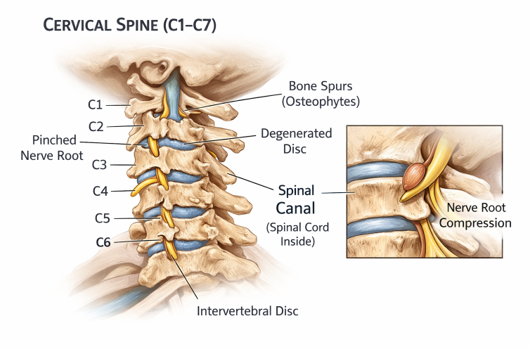
Your neck (cervical spine) is made of small bones, soft discs, and joints that hold up the weight of your head all day.
Over time — because of:
- phone and laptop use
- poor posture
- muscle weakness
- stress
- and natural aging
the soft discs between the bones lose water and flexibility.
They become thinner, and the small joints start taking more load.
To keep the spine stable, the body forms small bony edges called osteophytes.
This whole process is called cervical spondylosis.
It is not a disease —
it is a wear-and-adapt process.
As movement becomes less smooth:
- muscles tighten
- joints stiffen
- nerves may get irritated
This leads to:
- neck pain and stiffness
- cracking sounds
- shoulder or arm pain
- headaches starting from the neck
The good news?
This is not permanent damage.
With the right exercises, posture, and care, the neck can become comfortable again.
PART 3 — THE STAGES OF CERVICAL SPONDYLOSIS
Understanding which stage, you are in helps you choose the right exercises and avoid movements that can worsen your symptoms. Cervical spondylosis does not progress the same way in everyone. In my clinical experience, many people struggle simply because they treat the wrong stage the wrong way — this section helps you identify where you are and what your neck needs right now.
Cervical spondylosis does not appear all at once.
It develops slowly, in stages — and each stage needs a slightly different approach.
Understanding your stage helps you:
- stop unnecessary fear
- choose the right exercises
- avoid movements that worsen symptoms
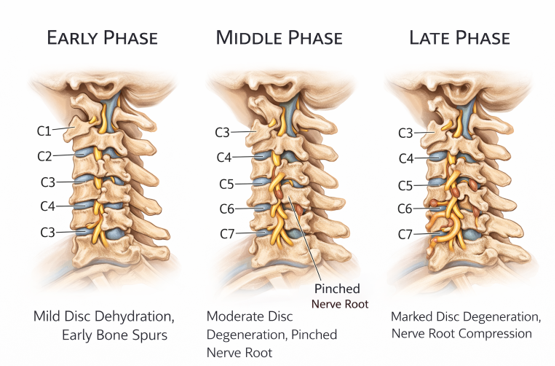
Most people are in the early or middle stage — and improve well with the right care.
Stage | What’s happening inside | How it feels | What helps most |
Early Stage | Discs start losing water, joints become slightly stiff | Morning stiffness, neck cracking, dull neck ache, posture-related pain | Posture correction, neck mobility, light strengthening |
Middle Stage | Discs thin more, joints inflamed, small bone spurs, mild nerve irritation | Neck pain spreading to shoulders or arms, tingling, tight muscles, headaches | Specific neck exercises, nerve-friendly movements, inflammation control |
Advanced Stage | Disc wear and bone spurs may compress nerves or spinal cord | Persistent arm pain, numbness, weakness, hand clumsiness, balance issues | Medical evaluation, imaging, guided physiotherapy, sometimes injections or surgery |
PART 4 — WHAT MAKES CERVICAL SPONDYLOSIS WORSE (AND HOW TO STOP IT)
Cervical spondylosis doesn’t usually get worse because of one big mistake.
It worsens because of small daily habits that quietly overload the neck again and again.
These are the most common ones I see in my patients.
- Looking down at your phone
When you tilt your head forward, the neck carries 3–4 times more weight.
Doing this for hours every day strains:
- discs
- joints
- neck muscles
What helps
- hold the phone at eye level
- bring the screen up — not your head down
- take a neck break every 30–40 minutes
- Poor sitting posture
Slouching makes the head fall forward and the shoulders roll in.
This puts constant tension on the neck and upper back.
What helps
- ears over shoulders
- shoulders relaxed back
- screen at eye level
- feet flat on the floor
- Wrong pillow or sleep position
Sleeping with the neck bent too much or unsupported increases:
- morning stiffness
- nerve irritation
- headaches
What helps
- pillow that keeps the neck neutral
- avoid very high or very flat pillows
- don’t sleep on the stomach
- Heavy bags & sudden jerky movements
- carrying heavy handbags or backpacks on one side
- sudden twisting or pulling
These overload an already sensitive neck.
What helps
- use backpacks with two straps
- avoid sudden neck movements
- move slowly and smoothly
- Complete rest out of fear
Avoiding all movement makes the neck:
- stiffer
- weaker
- more painful
What helps
Gentle, regular movement — not complete rest.
Simple rule
Bad posture and long stillness feed spondylosis.
Good posture and gentle movement heal it.
PART 5 — EXERCISES FOR CERVICAL SPONDYLOSIS (BASED ON YOUR STAGE)
Doing the wrong type at the wrong time can increase pain instead of helping.
These are safe, physiotherapy-based guidelines.
- Early Stage — When stiffness is the main problem
Goal: Restore movement and reduce muscle tightness
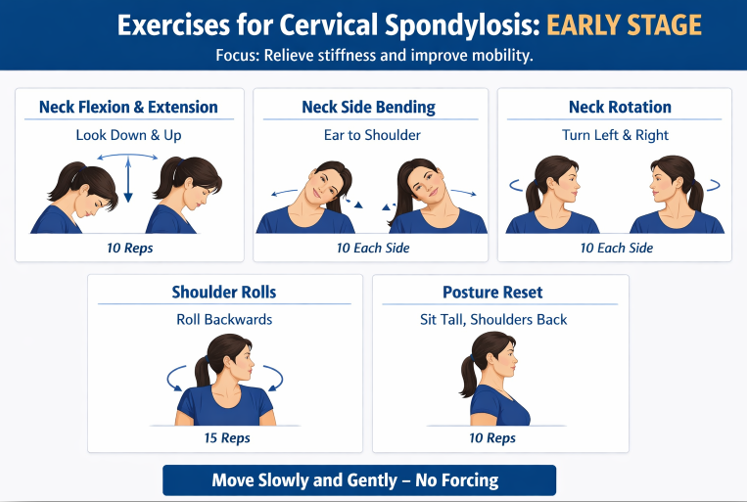
Exercise | How |
Neck flexion & extension | Slowly look down → up, 10 times |
Neck side bending | Ear to shoulder both sides, 10 each |
Neck rotation | Turn head left → right, 10 each |
Shoulder rolls | Backwards, 15 times |
Posture reset | Sit tall, pull shoulders back, 10 reps |
- Middle-Stage Exercises (when pain spreads to shoulder/arm)
Goal: Reduce nerve irritation, improve neck stability, and gently strengthen supporting muscles — without provoking symptoms.
Do these once or twice daily, slow and controlled.
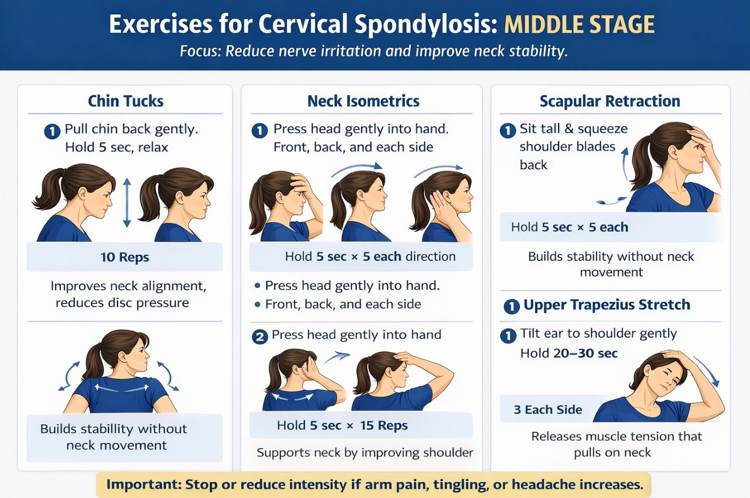
Exercise | How to do it | How many | What it helps |
Chin tucks | Pull chin gently backward, hold 5 seconds | 10 times | Reduces disc pressure & improves neck posture |
Neck isometrics | Press head gently into your hand (front, back, sides) | 5 reps each direction | Builds neck stability without movement |
Scapular retraction | Squeeze shoulder blades back and down | 15 reps | Supports neck by improving shoulder posture |
Upper trapezius stretch | Tilt ear toward shoulder, hold 20–30 sec | 3 each side | Releases tight neck muscles |
Posture reset | Sit tall, shoulders back, chin tucked | 10 reps | Reduces strain on neck & nerves |
Note- These exercises should feel supportive, not painful. If arm pain, tingling, or headache increases, reduce intensity or stop.
- Important note for the Advanced Stage
If you are experiencing persistent arm pain, numbness, weakness, clumsiness of the hands, or balance problems, your cervical spondylosis may be in an advanced stage. In this phase, aggressive stretching or self-treatment can make symptoms worse. These exercises should only be done under the guidance of a qualified physiotherapist or medical professional, and further medical evaluation may be needed.
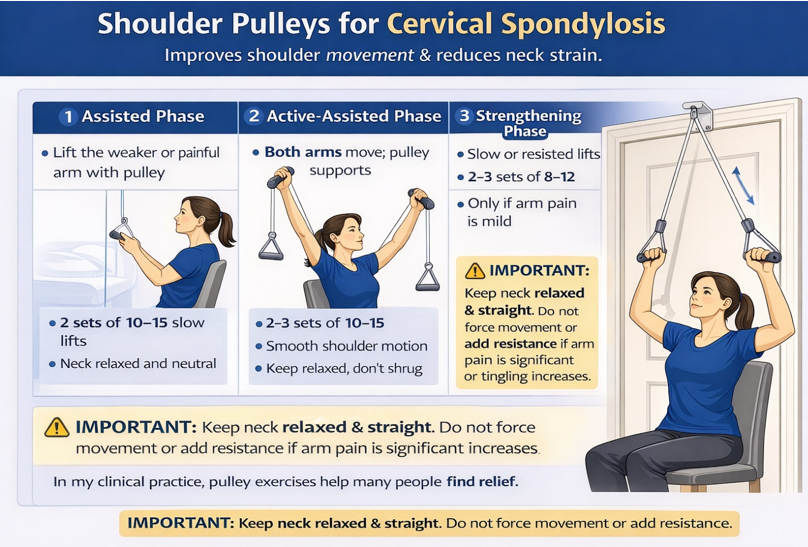
Advanced Stage — When Symptoms Are Persistent or Neurological
This stage is less common, but very important to recognise.
It usually involves nerve compression or spinal canal narrowing.
How it may feel
- persistent arm pain
- numbness or tingling in fingers
- weakness in grip or arm
- hand clumsiness (dropping things)
- balance or walking changes
These symptoms mean the neck needs more careful handling.
What helps most in this stage-
This phase is about protection, alignment, and gentle control — not force.
Focus | Why it matters |
Posture correction | Reduces pressure on nerves |
Gentle isometrics | Strengthens without moving painful joints |
Scapular stability | Supports neck and shoulders |
Nerve-friendly positions | Prevents worsening of tingling or pain |
Medical review | Ensures no serious compression |
Exercise | What to do |
Chin tucks | Gentle, short holds |
Neck isometrics | Very light pressure |
Scapular setting | Shoulder blade squeezes |
Deep breathing & relaxation | Reduces muscle guarding |
Avoid:
- forceful neck stretching
- rapid movements
- heavy resistance
- neck cracking
Key message
In the advanced stage, the goal is not to push —it is to protect and stabilise.
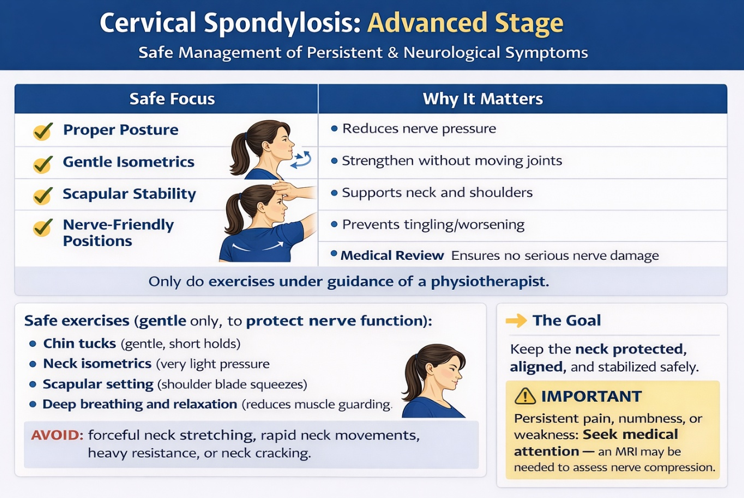
Shoulder Pulleys — A Powerful Add-On for Cervical Spondylosis
Neck pain and shoulder stiffness are closely linked.
When the shoulders become tight or weak, the neck has to work harder, which increases pain and nerve irritation.
In my clinical practice, many patients notice that their neck pain improves as their shoulder movement becomes freer with pulley exercises.
PART 6 — LIFESTYLE & SLEEP FOR CERVICAL SPONDYLOSIS
Neck pain is not only about discs and joints —
it is also affected by how you sit, sleep, work, and use your phone.
Small daily habits can either heal your neck or keep irritating it.
🛏️ Sleep tips
- Sleep on your back or side
- Use a pillow that keeps your neck in a neutral line
- Avoid very high or very flat pillows
- Do not sleep on your stomach
💻 Posture during the day
- Screen at eye level
- Ears above shoulders
- Avoid slouching or bending the neck forward for long
- Take a posture break every 30–40 minutes
📱 Phone & laptop use
- Bring the phone up to eye level
- Do not bring the head down
- Use both hands instead of one
🔥 Heat & cold
- Warm pack before exercises → reduces stiffness
- Cold pack if pain flares after activity
Simple rule
Support your neck at night. Move it gently during the day.
PART 7 — DIET & SUPPLEMENTS FOR CERVICAL SPONDYLOSIS
Your neck joints, discs, and nerves are affected by inflammation, muscle health, and circulation.
What you eat — and what you lack — can influence how much pain and stiffness you feel.
Diet that supports your neck
Focus on foods that reduce inflammation and support tissue healing:
Eat more of:
- green leafy vegetables (spinach, kale, lettuce, arugula)
- fruits rich in antioxidants (berries, citrus fruits, apples)
- nuts and seeds (almonds, walnuts, flax, chia)
- good protein sources (eggs, fish, chicken, tofu, beans, lentils, dairy)
- anti-inflammatory spices & herbs (turmeric, ginger, garlic)
- adequate water and fluids
Reduce or limit:
- added sugars (sweets, desserts, sweetened drinks)
- fried and greasy foods
- refined carbohydrates (white bread, pastries, noodles, bakery items)
- ultra-processed snacks (chips, packaged biscuits, instant foods)
- sugary beverages (soft drinks, sweetened juices, energy drinks)
- excess caffeine (too much coffee or tea)
These changes help reduce morning stiffness and nerve irritation.
Supplements that may help
These are commonly used to support neck pain and recovery: In my clinical practice, these supplements are used to support recovery along with physiotherapy.
Supplement | Why it helps | How to take |
Curcumin (with black pepper) | Reduces joint & nerve inflammation | 500–1000 mg once daily, after meals |
Omega-3 (Fish oil or algae oil) | Supports disc, nerve & joint health | 1000–2000 mg daily with food |
Vitamin D | Low levels worsen neck & muscle pain | 1000–2000 IU daily (if deficient) |
Magnesium (glycinate or citrate) | Relaxes neck muscles, improves sleep | 200–400 mg at night |
Collagen peptides | Supports discs, ligaments & soft tissues | 10–15 g daily with vitamin C |
Protein powder (if diet is low) | Helps muscle recovery & posture | 20–30 g once daily |
Always check with your doctor if you are pregnant, diabetic, on blood thinners, or have kidney or liver disease.
PART 8 — WHEN TO SEE A DOCTOR (RED FLAGS)
Most people with cervical spondylosis improve with physiotherapy, posture correction, and lifestyle care.
But some symptoms should never be ignored.
🚨 Seek medical help if you have:
- Severe or worsening neck or arm pain
- Persistent numbness or tingling
- Weakness in the arm or hand
- Difficulty holding objects or buttoning clothes
- Loss of balance or frequent falls
- Bladder or bowel changes
- Fever, unexplained weight loss, or night sweats
- History of cancer, infection, or trauma
⚠️ If you have diabetes
Neck nerve problems can progress faster.
Do not delay evaluation if tingling or weakness appears.
Important reminder-
Neck pain should gradually improve with the right care.
If it doesn’t — get it checked.
Need Personalized Guidance?
If you feel unsure about your symptoms or need individualized guidance beyond general information, you may consider a personal consultation.
Affiliate & Medical Disclaimer
Some links in this article are affiliate links, meaning I may earn a small commission at no extra cost to you. This support allows me to continue creating free, evidence-based health guides, exercises, and educational content. All recommendations are shared based on clinical experience and general wellness principles and are not intended to diagnose or treat medical conditions. Please consult a qualified healthcare professional before starting any supplement or treatment.
About Me
Chaya Gray
Quis autem vel eum iure repreherit qui in ea voluptate velit ess quam nihil molestiae consequatur velab illum denounci pleasure
Recent Blogs

Conveniently deploy accurate …
Conveniently deploy accurate …